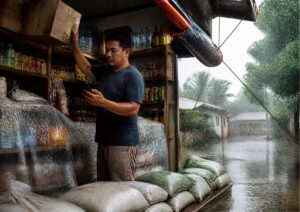
Negosentro | Rain or Shine: Turning the Philippine Rainy Season Into a Business Advantage
For many Filipino small-business owners, the rainy season is something to endure.
When the streets flood, customers stay home. Deliveries slow down. Employees struggle to get to work. Inventory can be damaged. Power interruptions can bring operations to a halt. And for businesses operating on thin margins, even a few days of disruption can hurt.
But there is another way to look at the rainy season.
Rain creates problems—and problems create demand.
For entrepreneurs willing to prepare early and observe what their communities need, the rainy season can become more than a period of risk. It can become a season of opportunity.
The key is to stop asking only, “How can my business survive the rain?”
Instead, ask:
“What will people need because of the rain?”
That simple change in perspective can uncover surprisingly good business ideas.
Start by protecting the business you already have
Before thinking about new opportunities, protect your existing operation.
For businesses located in flood-prone communities, preparedness should begin with a simple assessment. Which areas of the store are most vulnerable? How high has floodwater reached in previous years? Which products can be damaged by water? Which equipment should be moved to higher ground? Which roads become difficult or impossible to pass?
Don’t wait until the rain is already pouring.
Move important inventory off the floor. Elevate computers, appliances and electrical equipment. Protect business documents. Keep digital copies of critical records. Make sure employees know whom to contact during an emergency.
PAGASA’s flood-safety guidance emphasizes preparedness, monitoring weather conditions and moving people and belongings to safer locations when flooding threatens.
For an entrepreneur, that translates into one very practical rule:
Prepare for the worst day before it arrives.
Your business should have a Plan B
A small business doesn’t need a complicated disaster-management department.
It needs alternatives.
If your usual supplier cannot deliver, who is your second supplier?
If your physical store cannot open, can you accept orders online?
If employees cannot travel, which tasks can be performed remotely?
If electricity goes out, how long can you continue operating?
If your delivery rider cannot pass through one road, is there another route?
These questions may sound basic, but they can make the difference between a business that temporarily pauses and one that loses customers permanently.
Business continuity is particularly important for MSMEs because smaller companies generally have fewer financial and operational resources to absorb prolonged disruptions.
The goal isn’t to eliminate every risk.
It’s to make sure one problem doesn’t become five problems.
Then look around. What is everyone suddenly looking for?
This is where entrepreneurship gets interesting.
When flooding occurs, consumer priorities change.
People need drinking water. Food that can be stored. Ready-to-eat meals. Flashlights. Batteries. Cleaning materials. Waterproof containers. Charging services. Transportation. Laundry services.
And after the flood, they need something else:
Cleanup.
That creates potential opportunities for entrepreneurs.
A small hardware retailer could assemble “Flood Ready Kits” containing practical household essentials.
A neighborhood restaurant could offer rainy-day meal packages with scheduled delivery to accessible areas.
A laundry shop could provide wet-weather pickup and delivery, particularly for uniforms, towels and work clothes.
A cleaning business could specialize in post-flood cleaning and sanitation.
Someone with a reliable vehicle could provide neighborhood delivery or transport services when normal routes become difficult.
Even a small entrepreneur with a secure garage or storage area could potentially offer temporary elevated storage for nearby businesses protecting inventory from floodwater.
None of these ideas requires inventing a revolutionary technology.
They simply require noticing a problem and solving it better.
The biggest opportunity may be helping other businesses
Here’s an idea worth considering: don’t focus only on consumers.
Think about your fellow entrepreneurs.
When flooding disrupts one business, it can disrupt several others connected to it.
A restaurant needs ingredients.
A retailer needs inventory.
A hotel needs food and linens.
A small manufacturer needs raw materials.
An office needs supplies and connectivity.
A pharmacy needs deliveries.
This creates opportunities for businesses that can provide emergency logistics, alternative delivery, temporary storage, equipment repair, cleaning, supplies and other services that help companies remain operational.
In other words, business resilience can itself become a business.
An entrepreneur who understands local roads, suppliers and delivery routes may be able to provide valuable services that larger companies cannot provide as quickly.
Sometimes the competitive advantage isn’t having more resources.
It’s knowing the neighborhood better.
Don’t forget the digital opportunity
Rain doesn’t necessarily stop people from using their phones.
In fact, when customers are stuck at home, digital communication becomes even more important.
A business can continue taking orders through social media and messaging platforms. It can announce which products are available, which branches are open, which areas can still be served and when deliveries are expected.
This is also an opportunity for businesses that normally depend heavily on foot traffic.
A café could promote delivery bundles.
A grocery could offer neighborhood ordering.
A salon could sell prepaid services.
A retailer could promote online ordering and pickup when conditions improve.
The lesson is important:
When the physical customer journey becomes difficult, strengthen the digital one.
Rainy-season marketing should solve a problem
There is also a lesson here for marketing.
Instead of simply advertising “20% OFF THIS WEEKEND,” businesses can make their promotions relevant to what customers are experiencing.
“Rainy-day essentials.”
“Stay-home meal bundle.”
“Flood cleanup package.”
“Free delivery within accessible areas.”
“Emergency office supplies.”
“Keep your uniforms dry and ready for work.”
These aren’t just promotions.
They’re solutions packaged as products.
And that makes them much more compelling.
Prepare your people, too
A business continuity plan is useless if employees don’t know what to do.
Everyone should understand basic procedures for severe weather: who makes the decision to close, how employees communicate, what happens to inventory, how customers are informed and what happens when someone cannot safely travel to work.
Most importantly, don’t make employees choose between their safety and their job.
A responsible rainy-season policy recognizes that employees are part of the business’s resilience—not simply resources expected to report regardless of circumstances.
When people know that their safety matters, they are more likely to trust the business and help it recover.
The opportunity after the flood
Entrepreneurs should also think beyond the rainy day itself.
Flooding creates a cycle of needs.
Before the rain: waterproofing, emergency supplies and preparation.
During the rain: food, water, delivery, transportation and communication.
After the flood: cleaning, repairs, replacement goods, laundry, construction and replenishment.
That means one rainy-season business can potentially serve customers across three different stages of demand.
The entrepreneur who sees that cycle can plan inventory, promotions and services accordingly.
Don’t just survive the rainy season
The Philippines will continue to experience heavy rains, storms and flooding. For many communities, these are not unusual events but recurring realities.
Small businesses cannot control the weather.
But they can control how prepared they are.
They can protect inventory. Build supplier relationships. Back up data. Create alternative delivery routes. Communicate with customers. Train employees. And, most importantly, listen to what their communities need.
Because every difficult situation contains information.
A flooded road tells you something about logistics.
An empty grocery shelf tells you something about demand.
A cancelled delivery tells you something about supply chains.
A long queue for a service tells you something about an unmet need.
Entrepreneurs who pay attention can turn those signals into opportunities.
The rainy season, then, doesn’t have to be viewed simply as a threat to Philippine small businesses.
It can be a reminder of what entrepreneurship is really about:
Seeing a problem that everyone else sees—and finding a way to solve it.
So when the next dark clouds gather, don’t just ask whether your business is ready for the rain.
Look around.
There may be a customer waiting for exactly the solution you’re capable of providing.
Rain or shine, that’s where opportunity begins.